

2023 PassReview Fortinet NSE7_LED-7.0 Dumps and Exam Test Engine
Fortinet NSE7_LED-7.0 DUMPS WITH REAL EXAM QUESTIONS
NEW QUESTION # 19
Which two statements about MAC address quarantine by redirect mode are true? (Choose two)
- A. It is the default mode for MAC address quarantine
- B. The quarantined device is moved to the quarantine VLAN
- C. The device MACaddress is added to the Quarantined Devices firewall address group
- D. The quarantined device is kept in the current VLAN
Answer: C,D
Explanation:
Explanation
According to the FortiGate Administration Guide, "MAC address quarantine by redirect mode allows you to quarantine devices by adding their MAC addresses to a firewall address group called Quarantined Devices.
The quarantined devices are kept in their current VLANs, but their traffic is redirected to a quarantine portal." Therefore, options B and D are true because they describe the statements about MAC address quarantine by redirect mode. Option A is false because the quarantined device is not moved to the quarantine VLAN, but rather kept in the current VLAN. Option C is false because redirect mode is not the default mode for MAC address quarantine, but rather an alternative mode that can be enabled by setting mac-quarantine-mode to redirect.
https://docs.fortinet.com/document/fortiap/7.0.0/configuration-guide/734537/radius-authenticated-dynamic-vlan-: https://docs.fortinet.com/document/fortigate/7.0.0/administration-guide/734537/mac-address-quarantine
NEW QUESTION # 20
Which FortiSwitch VLANs are automatically created on FortGate when the first FortiSwitch device is discovered1?
- A. access, quarantine, rspan. voice, video, and onboarding
- B. fortilink. quarantine erspan voice video and onboarding
- C. default quarantine, rspan voice video onboarding and nac_segment
- D. default quarantine rspan voice video and nac_segment
Answer: B
Explanation:
Explanation
According to the FortiGate Administration Guide, "When you add a FortiSwitch device to the Security Fabric, FortiGate automatically creates the following VLANs on theFortiSwitch device: fortilink, quarantine, erspan, voice, video, and onboarding." Therefore, option D is true because it lists the FortiSwitch VLANs that are automatically created on FortiGate when the first FortiSwitch device is discovered. Option A is false because default and nac_segment are not among the automatically created VLANs. Option B is false because access and rspan are not among the automatically created VLANs. Option C is false because default and nac_segment are not among the automatically created VLANs.
NEW QUESTION # 21
Refer to the exhibit.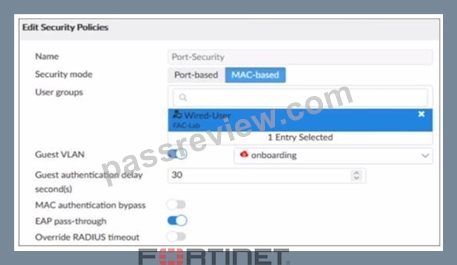
Examine the FortiSwitch security policy shown in the exhibit
If the security profile shown in the exhibit is assigned to all ports on a FortiSwitch device for 802 1X authentication which statement about the switch is correct?
- A. FortiSwitch will try to authenticate non-802 1X devices using the device MAC address as the username and password
- B. FortiSwitch will assign non-802 1X devices to the onboarding VLAN
- C. FortiSwitch cannot authenticate multiple devices connected to the same port
- D. All EAP messages will be terminated on FortiSwitch
Answer: B
Explanation:
Explanation
According to the FortiSwitch Administration Guide, "If a device does not support 802.1X authentication, you can configure the switch to assign the device to an onboarding VLAN. The onboarding VLAN is a separate VLAN that you can use to provide limited network access to non-802.1X devices." Therefore, option C is true because it describes the behavior of FortiSwitch when the security profile shown in the exhibit is assigned to all ports. Option A is false because FortiSwitch can authenticate multiple devices connected to the same port using MAC-based or MAB-EAP modes. Option B is false because FortiSwitch will not try to authenticate non-802.1X devices using the device MAC address as the username and password, but rather use MAC authentication bypass (MAB) or EAP pass-through modes. Option D is false because all EAP messages will be terminated on FortiGate, not FortiSwitch, when using 802.1X authentication.
NEW QUESTION # 22
You are investigating a report of poor wireless performance in a network that you manage. The issue is related to an AP interface in the 5 GHz range You are monitoring the channel utilization over time.
What is the recommended maximum utilization value that an interface should not exceed?
- A. 85%
- B. 75%
- C. 95%
- D. 65%
Answer: D
Explanation:
Explanation
According to the FortiAP Configuration Guide, "Channel utilization measures how busy a channel is over a given period of time. It includes both Wi-Fi and non-Wi-Fi interference sources. A high channel utilization indicates a congested channel and can result in poor wireless performance. The recommended maximum utilization value that an interface should not exceed is 65%." Therefore, option D is true because it gives the recommended maximum utilization value for an interface in the 5 GHz range. Options A, B, and C are false because they give higher utilization values that can cause poor wireless performance.
https://docs.fortinet.com/document/fortiap/7.0.0/configuration-guide/734537/wireless-radio-settings#channel-uti
NEW QUESTION # 23
You are configuring a FortiGate wireless network to support automated wireless client quarantine using IOC Which two configurations must you put in place for a wireless client to be quarantined successfully? (Choose two)
- A. Configure a firewall policy to allow communication
- B. Configure the wireless network to be in tunnel mode
- C. Configure the FortiGate device in the Security Fabric with a FortiAnalyzer device
- D. Configure the wireless network to be in bridge mode
Answer: B,C
Explanation:
Explanation
According to the FortiGate Administration Guide, "To enable automated wireless client quarantine using IOC, you must configure the following settings: Configure your wireless network to be in tunnel mode. This allows FortiGate to inspect all wireless traffic and applysecurity policies. Configure your FortiGate device in the Security Fabric with a FortiAnalyzer device. This allows FortiAnalyzer to detect indicators of compromise (IOC) from wireless traffic and send quarantine commands to FortiGate." Therefore, options A and B are true because they describe the configurations that must be put in place for a wireless client to be quarantined successfully using IOC. Option C is false because configuring a firewall policy to allow communication is not required, as the default firewall policy for tunnel mode wireless networks is to allow all traffic. Option D is false because configuring the wireless network to be in bridge mode is not supported, as FortiGate cannot inspect or quarantine wireless traffic in bridge mode.
NEW QUESTION # 24
Refer to the exhibit.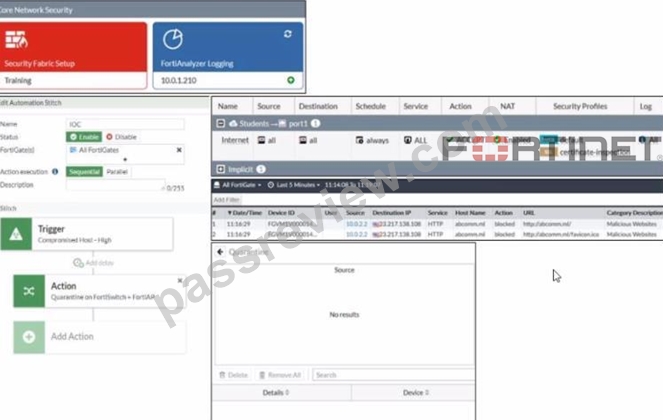
Examine the FortiGate configuration FortiAnalyzer logs and FortiGate widget shown in the exhibit An administrator is testing the Security Fabric quarantine automation The administrator added FortiAnalyzer to the Security Fabric and configured an automation stitch to automatically quarantine compromised devices The test device (::.:.:.!) s connected to a managed Fort Switch dev :e After trying to access a malicious website from the test device, the administrator verifies that FortiAnalyzer has a log (or the test connection However the device is not getting quarantined by FortiGate as shown in the quarantine widget Which two scenarios are likely to cause this issue? (Choose two)
- A. The device does not have FortiClient installed
- B. FortiAnalyzer does not consider the malicious website an indicator of compromise (IOC)
- C. FortiAnalyzer does not have a valid threat detection services license
- D. The web filtering rating service is not working
Answer: B,C
Explanation:
Explanation
According to the exhibits, the administrator has configured an automation stitch to automatically quarantine compromised devices based on FortiAnalyzer's threat detection services. However, according to the FortiAnalyzer logs, the test device is not detected as compromised by FortiAnalyzer, even though it tried to access a malicious website. Therefore, option B is true because FortiAnalyzer does not have a valid threat detection services license, which is required to enable the threat detection services feature. Option D is also true because FortiAnalyzer does not consider the malicious website an indicator of compromise (IOC), which is a criterion for identifying compromised devices. Option A is false because the web filtering rating service is working, as shown by the log entry that indicates that the test device accessed a URL with a category of
"Malicious Websites". Option C is false because the device does not need to have FortiClient installed to be quarantined by FortiGate, as long as it is connected to a managed FortiSwitch device.
NEW QUESTION # 25
Which two statements about the MAC-based 802 1X security mode available on FortiSwitch are true? (Choose two.)
- A. FortiSwitch authenticates each device connected to the port
- B. FortiSwitch can grant different access levels to each device connected to the port
- C. FortiSwitch authenticates a single device and opens the port to other devices connected to the port
- D. It cannot be used in conjunction with MAC authentication bypass
Answer: A,B
Explanation:
Explanation
According to the FortiSwitch Administration Guide, "MAC-based 802.1X security mode allows you to authenticate each device connected to a port using its MAC address as the username and password." Therefore, option B is true because it describes the MAC-based 802.1X security mode available on FortiSwitch. Option D is also true because FortiSwitch can grant different access levels to each device connected to the port based on the user group and security policy assigned to them. Option A is false because FortiSwitch does not authenticate a single device and open the port to other devices connected to the port, but rather authenticates each device individually. Option C is false because MAC-based 802.1X security mode can be used in conjunction with MAC authentication bypass (MAB) or EAP pass-through modes, which are fallback options for non-802.1X devices.
NEW QUESTION # 26
Which two statements about FortiSwitchmanager are true1? (Choose two)
- A. Per-device management is the default management mode on FortiManager
- B. FortiManager obtains the FortiSwitch status information by querying the FortiGate REST API every three minutes
- C. If the administrator makes any changes on FortiSwitch manager they must also install those changes on FortiGate so that those changes are applied on the managed switches
- D. Any switch discovered or authorized on FortiGate must be added manually on FortiSwitch manager
Answer: B,C
Explanation:
Explanation
According to the FortiManager Administration Guide1, "FortiManager obtains the FortiSwitch status information by querying the FortiGate REST API every three minutes." Therefore, option B is true because it describes how FortiManager gets the information about the managed switches. According to the same guide2,
"If you make any changes in this module, you must install them on your managed device so that they are applied on your managed switches." Therefore, option C is true because it describes what the administrator must do after making any changes on FortiSwitch manager. Option A is false because central management is the default management mode on FortiManager, not per-device management. Option D is false because anyswitch discovered or authorized on FortiGate will be automatically added on FortiSwitch manager, not manually.
1: https://docs.fortinet.com/document/fortimanager/7.0.0/administration-guide/734537/fortiswitch-manager 2:
https://docs.fortinet.com/document/fortimanager/7.0.0/administration-guide/734537/fortiswitch-manager#fortisw
NEW QUESTION # 27
Refer to the exhibit.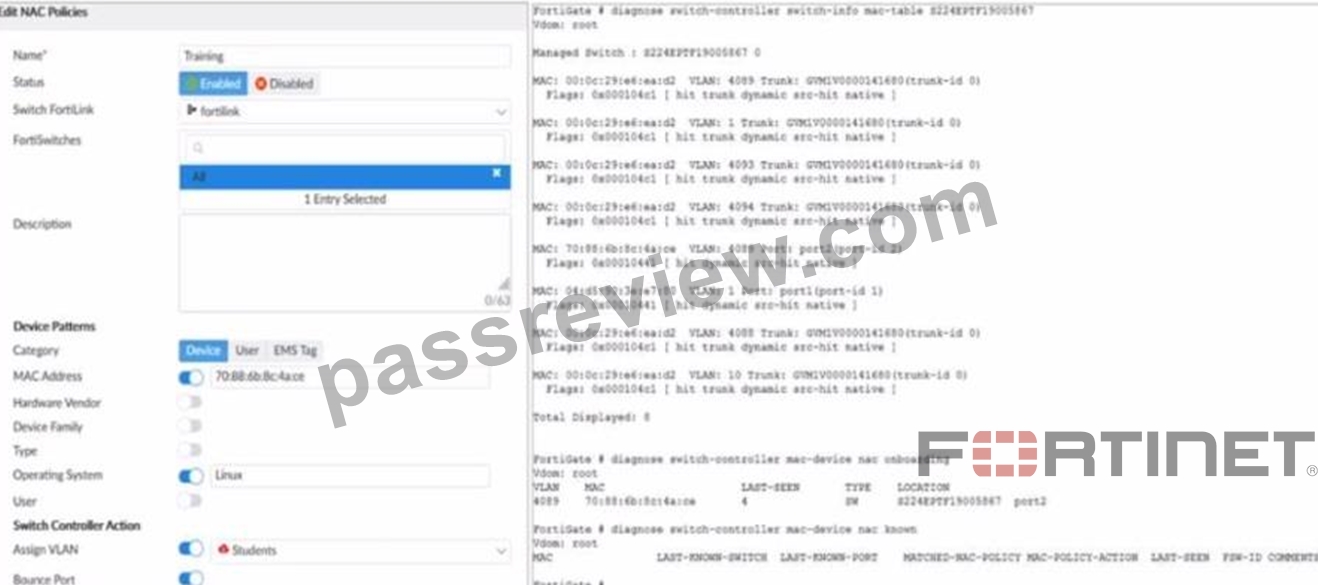
Examine the FortiManager configuration and FortiGate CLI output shown in the exhibit An administrator is testing the NAC feature The test device is connected to a managed FortiSwitch device
{S224EPTF19"53C7)onpOrt2
After applying the NAC policy on port2 and generating traffic on the test device the test device is not matching the NAC policy therefore the test device remains m the onboarding VLAN Based on the information shown in the exhibit which two scenarios are likely to cause this issue? (Choose two.)
- A. Device detection is not enabled on VLAN 4089
- B. The MAC address configured on the NAC policy is incorrect
- C. The device operating system detected by FortiGate is not Linux
- D. Management communication between FortiGate and FortiSwitch is down
Answer: B,D
Explanation:
Explanation
According to the FortiManager configuration, the NAC policy is set to match devices with the MAC address of 00:0c:29:6a:2b:3c and the operating system of Linux.However, according to the FortiGate CLI output, the test device has a different MAC address of 00:0c:29:6a:2b:3d. Therefore, option B is true. Option A is also true because the FortiSwitch device status is shown as down, which means that the management communication between FortiGate and FortiSwitch is not working properly. This could prevent the NAC policy from being applied correctly. Option C is false because the device operating system detected by FortiGate is Linux, which matches the NAC policy. Option D is false because device detection is enabled on VLAN 4089, as shown by the command "config switch-controller vlan".
NEW QUESTION # 28
Exhibit.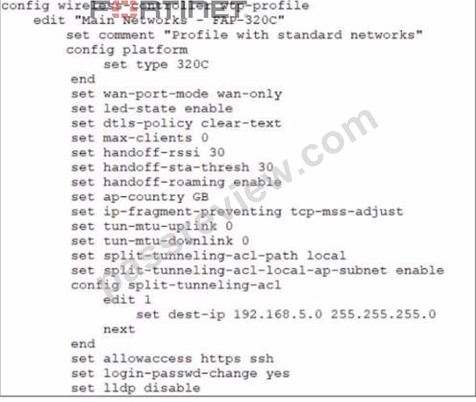
Exhibit.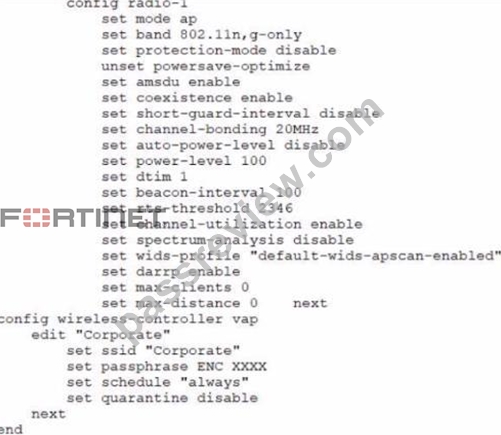
Refer to the exhibits
In the wireless configuration shown in the exhibits, an AP is deployed in a remote site and has a wireless network (VAP) called Corporate deployed to it The network is a tunneled network however clients connecting to a wireless network require access to a local printer Clients are trying to print to a printer on the remote site but are unable to do so Which configuration change is required to allow clients connected to the Corporate SSID to print locally?
- A. Disable the Block Intra-SSID Traffic (intra-vap-privacy) setting on the SSID (VAP) profile
- B. Configure the printer as a wireless client on the Corporate wireless network
- C. Configure split-tunneling in the vap configuration
- D. Configure split-tunneling in the wtp-profile configuration
Answer: C
Explanation:
Explanation
According to the Fortinet documentation1, "Split tunneling allows you to specify which traffic is tunneled to the FortiGate and which traffic is sent directly to the Internet. This can improve performance and reduce bandwidth usage." Therefore, by configuring split-tunneling in the vap configuration, you can allow the clients connected to the Corporate SSID to access both the corporate network and the local printer. Option B is incorrect because split-tunneling is configured at the vap level, not the wtp-profile level. Option C is incorrect because blocking intra-SSID traffic prevents wireless clients on the same SSID from communicating with each other, which is not related to accessing a local printer. Option D is unnecessary and impractical because the printer does not need to be a wireless client on the Corporate wireless network to be accessible by the clients.
NEW QUESTION # 29
When you configure a FortiAP wireless interface for auto TX power control which statement describes how it configures its transmission power"?
- A. Every 30 seconds FortiGate measures the signal strength of the weakest associated client The AP will then configure its radio power to match the detected signal strength of the client
- B. Every 30 seconds FortiGate measures the signal strength of adjacent FortiAP interfaces It will adjust the adjacent AP power to be detectable at -70 dBm
- C. Every 30 seconds the AP will measure the signal strength of the AP using the client The AP will adjust its signal strength up or down until the AP signal is detected at -70 dBm
- D. Every 30 seconds FortiGate measures the signal strength of adjacent AP interfaces It will adjust its own AP power to match the adjacent AP signal strength
Answer: C
Explanation:
Explanation
According to the FortiAP Configuration Guide1, "Auto TX power control allows the AP to adjust its transmit power based on the signal strength of the client. The AP will measure the signal strength of the client every 30 seconds and adjust its transmit power up or down until the client signal is detected at -70 dBm." Therefore, option A is true because it describes how the FortiAP wireless interface configures its transmission power when auto TX power control is enabled. Option B is false because FortiGate does not measure the signal strength of adjacent AP interfaces, but rather the FortiAP does. Option C is false because FortiGate does not adjust the adjacent AP power, but rather the FortiAP adjusts its own power. Option D is false becauseFortiGate does not measure the signal strength of the weakest associated client, but rather the FortiAP does.
NEW QUESTION # 30
A wireless network in a school provides guest access using a captive portal to allow unregistered users to self-register and access the network The administrator is requested to update the existing configuration to provide captive portal authentication through a secure connection (HTTPS) Which two changes must the administrator make to enforce HTTPS authentication"? (Choose two >
- A. Update the captive portal URL to use HTTPS on FortiGate and FortiAuthenticator
- B. Disable HTTP administrative access on the guest SSID to enforce HTTPS connection
- C. Enable HTTP redirect in the user authentication settings
- D. Create a new SSID with the HTTPS captive portal URL
Answer: A,C
Explanation:
Explanation
According to the FortiGate Administration Guide, "To enable HTTPS authentication, you must enable HTTP redirect in the user authentication settings. This redirects HTTP requests to HTTPS. You must also update the captive portal URL to use HTTPS on both FortiGate and FortiAuthenticator." Therefore, options B and D are true because they describe the changes that the administrator must make to enforce HTTPS authentication for the captive portal. Option A is false because creating a new SSID with the HTTPS captive portal URL is not required, as the existing SSID can be updated with the new URL. Option C is false because disabling HTTP administrative access on the guest SSID will not enforce HTTPS connection, but rather block HTTP connection.
NEW QUESTION # 31
Refer to the exhibits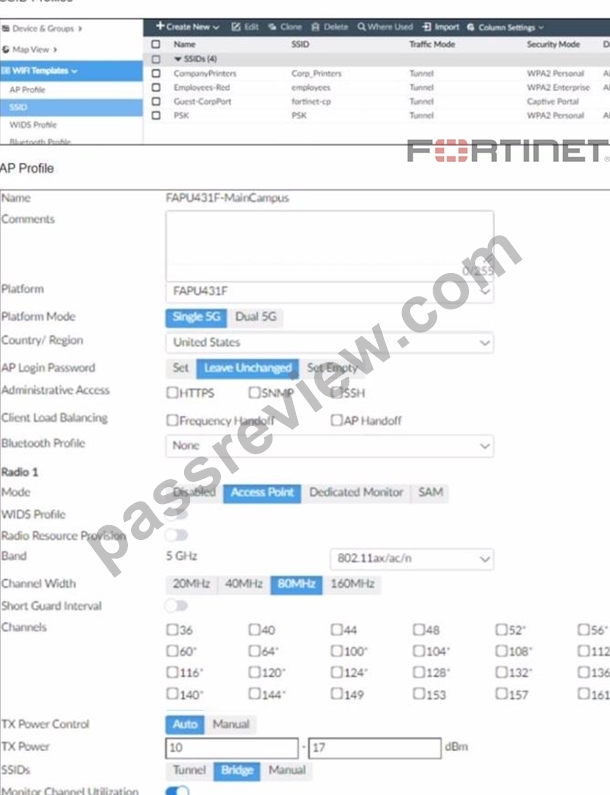
The exhibits show the wireless network (VAP) SSID profiles defined on FortiManager and an AP profile assigned to a group of APs that are supported by FortiGate None of the APs are broadcasting the SSlDs defined by the AP profile Which changes do you need to make to enable the SSIDs to broadcast?
- A. In the SSIDs section enable Manual and assign the networks manually
- B. In the SSIDs section enable Tunnel
- C. Enable one channel in the Channels section
- D. Enable multiple channels in the Channels section and enable Radio Resource Provision
Answer: C
Explanation:
Explanation
According to the FortiManager Administration Guide1, "To enable the SSID, you must select at least one channel for the radio. If no channels are selected, the SSID will not be enabled." Therefore, enabling one channel in the Channels section will allow the SSIDs to broadcast.
NEW QUESTION # 32
Which two pieces of information can the diagnose test authserver ldap command provide? (Choose two.)
- A. It displays the LDAP groups found for the user
- B. It displays the LDAP codes returned by the LDAP server
- C. It displays whether the user credentials are correct
- D. It displays whether the admin bind user credentials are correct
Answer: B,C
Explanation:
Explanation
According to the FortiGate CLI Reference Guide, "The diagnose test authserver ldap command tests LDAP authentication with a specific LDAP server. The command displays whether the user credentials are correct and whether the user belongs to any groups that match a firewall policy. The command also displays the LDAP codes returned by the LDAP server." Therefore, options B and C are true because they describe the information that the diagnose test authserver ldap command can provide. Option A is false because the command does not display whether the admin bind user credentials are correct, but rather whether the user credentials are correct. Option D is false because the command does not display the LDAP groups found for the user, but rather whether the user belongs to any groups that match a firewall policy.
NEW QUESTION # 33
Refer to the exhibits.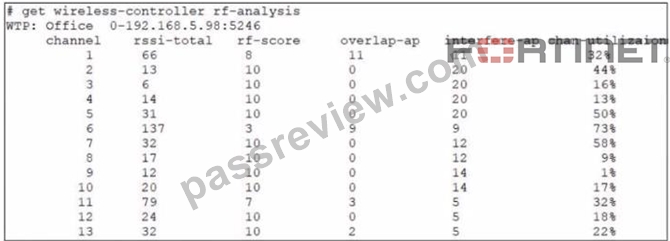
Exhibit.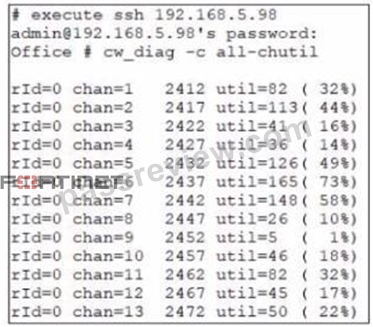
Examine the troubleshooting outputs shown in the exhibits
Users have been reporting issues with the speed of their wireless connection in a particular part of the wireless network The interface that is having issues is the 2 4 GHz interface that is currently configured on channel 6 The administrator of the wireless network has investigated and surveyed the local RF environment using the tools available at the AP and FortiGate Which configuration would improve the wireless connection?
- A. Change the AP 2 4 GHz channel to 11
- B. Change the AP 2 4 GHz channel to 9.
- C. Change the AP 2 4 GHz channel to 13.
- D. Change the AP 2 4 GHz channel to 1.
Answer: D
Explanation:
Explanation
According to the exhibits, the AP 2.4 GHz interface is currently configured on channel 6, which is overlapping with other nearby APs on channels 4 and 8. This can cause interference and reduce the wireless performance.
Therefore, changing the AP 2.4 GHz channel to 1 would improve the wireless connection, as it would avoid the overlapping channels and use a non-overlapping channel instead. Option A is false because changing the AP 2.4 GHz channel to 11 would still overlap with other nearby APs on channels 9 and 13. Option C is false because changing the AP 2.4 GHz channel to 9 would still overlap with other nearby APs on channels 6, 8, and 11. Option D is false because changing the AP 2.4 GHz channel to 13 would still overlap with other nearby APs on channels 9 and 11.
NEW QUESTION # 34
Refer to the exhibit.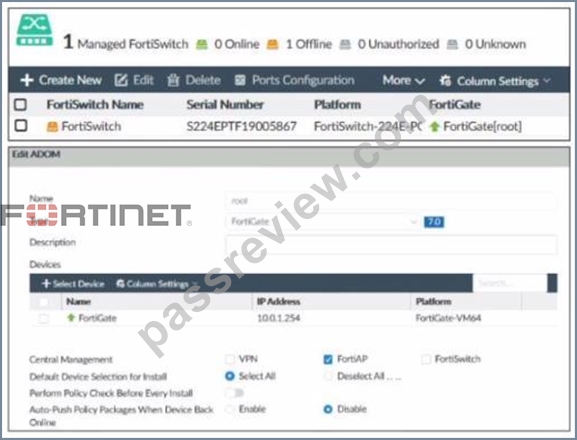
Examine the FortiManager information shown in the exhibit
Which two statements about the FortiManager status are true'' (Choose two)
- A. FortiSwitch is authorized and offline
- B. FortiSwitch is not authorized
- C. FortiSwitch manager is working in per-device management mode
- D. FortiSwitch manager is working in central management mode
Answer: A,D
Explanation:
Explanation
According to the FortiManager Administration Guide, "Central management mode allows you to manage all FortiSwitch devices from a single interface on the FortiManager device." Therefore, option C is true because the exhibit shows that the FortiSwitch manager is enabled and the FortiSwitch device is managed by the FortiManager device. Option D is also true because the exhibit shows that the FortiSwitch device status is offline, which means that it is not reachable by the FortiManager device, but it is authorized, which means that it has been added to the FortiManager device. Option A is false because per-device management mode allows you to manage each FortiSwitch device individually from its own web-based manager or CLI, which is not the case in the exhibit. Option B is false because the FortiSwitch device is authorized, as explained above.
NEW QUESTION # 35
......
2023 New PassReview NSE7_LED-7.0 PDF Recently Updated Questions: https://www.passreview.com/NSE7_LED-7.0_exam-braindumps.html
NSE7_LED-7.0 Exam with Guarantee Updated 40 Questions: https://drive.google.com/open?id=1pqNdh3RF7yhGKseBlk-9_bMbjffmDFco