


Since our Microsoft AI-300 exam review materials are accurate and valid our service is also very good. We are 7*24 online service. When you want to ask any questions or share with us your AI-300 passing score you will reply you in 3 hours. We have one-year service warranty that we will send you the latest AI-300 exam review materials if you want or other service. If you pass AI-300 with a good mark and want to purchase other Microsoft exams review materials we will give you discount. Or if you stands for your company and want to long-term cooperate with us we welcome and give you 50%+ discount from the second year.

Our IT system department staff checks the updates every day. Once the AI-300 exam review materials are updated we will notice our customers ASAP. We make sure that all AI-300 exam review materials we sell out are accurate, AI-300 valid and latest. As for the payment we advise people using the Credit Card which is a widely used in international online payments and the safer, faster way to send money, receive money or set up a merchant account for both buyers and sellers. If you have any query about the payment we are pleased to solve for you. (AI-300 pass review - Operationalizing Machine Learning and Generative AI Solutions)
We assure you 100% pass for sure. If you fail the AI-300 exam you can send us your unqualified score we will full refund to you or you can choose to change other subject exam too. We aim to "Customer First, Service Foremost", that's why we can become the PassReview in this area.
Instant Download AI-300 Exam Braindumps: Upon successful payment, Our systems will automatically send the product you have purchased to your mailbox by email. (If not received within 12 hours, please contact us. Note: don't forget to check your spam.)
Microsoft AI-300 Exam Syllabus Topics:
| Section | Objectives |
|---|---|
| Design and implement an MLOps infrastructure | - Configure source control, CI/CD pipelines, and automation for ML workflows - Implement security, governance, and compliance for MLOps - Manage environments, data stores, and model registries - Set up Azure Machine Learning workspace and compute targets |
| Implement machine learning model lifecycle and operations | - Monitor model performance, data drift, and operational health - Train, register, and version models using Azure Machine Learning - Retrain, update, and manage model versions in production - Deploy models to real-time and batch endpoints |
| Optimize generative AI systems and model performance | - Implement cost management and scaling strategies for GenAI workloads - Optimize inference performance, caching, and throughput - Fine-tune and distill models for specific use cases - Tune prompts, system messages, and grounding strategies |
| Design and implement a GenAIOps infrastructure | - Configure prompt orchestration, prompt flows, and agent frameworks - Set up Microsoft Foundry and Azure AI services for generative AI workloads - Implement RAG (Retrieval-Augmented Generation) pipelines and vector search - Manage API keys, rate limits, and responsible AI guardrails |
| Implement generative AI quality assurance and observability | - Monitor latency, token usage, cost, and error rates - Implement logging, tracing, and telemetry for GenAI applications - Conduct red teaming, adversarial testing, and content filtering - Evaluate generative AI outputs for quality, safety, and grounding |
Microsoft Operationalizing Machine Learning and Generative AI Solutions Sample Questions:
You create an Azure Machine Learning workspace and install the MLflow library.
You need to tog different types of data by using the MLflow library.
Which method should you use? To answer, select the appropriate options in the answer area.
NOTE: Each correct selection is worth one point.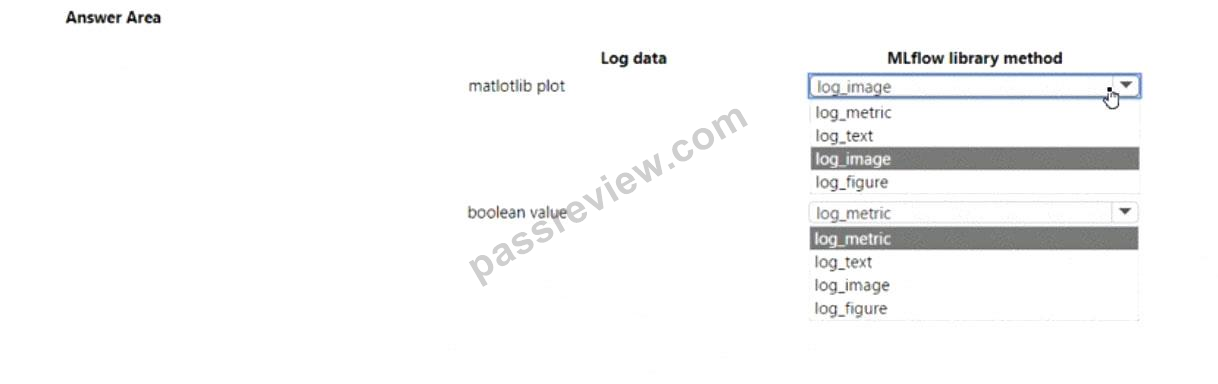
Correct Answer:

Explanation:
A data science team trains a model that depends on features that are stored in a managed feature store.
The model is registered in Azure Machine Learning and will be deployed to a real-time endpoint.
After deployment, the model must:
* Retrieve feature values dynamically at inference time.
* Use the same feature definitions that were used during training.
* Run without manual configuration changes across environments.
You need to define feature store entities so that feature retrieval behaves as expected when the model is deployed.
Which feature store entity should you select for each requirement? To answer, move the appropriate feature store entities to the correct requirements. You may use each feature store entity once, more than once, or not at all. You may need to move the split bar between panes or scroll to view content.
NOTE: Each correct selection is worth one point.
Correct Answer:

Explanation:
Define how features are retrieved at inference: Feature retrieval specification Ensure feature consistency between training and inference: Feature retrieval specification Enable automated feature lookup in production: Feature retrieval specification The feature retrieval specification is the key model-level contract for all three requirements. Microsoft defines it as a portable specification containing the exact list of features associated with a model, including the relevant feature store, feature set, and feature-set version . The same specification participates in both training and inference, making it the connective artifact across the model lifecycle.
During training, the feature retrieval specification is used to obtain the required feature values and generate training data. Microsoft requires the specification to be packaged with the model artifact when the model depends on feature-store features. At online inference time, the scoring script loads this packaged specification, resolves the feature list, and initializes online feature lookup before calling the feature store to retrieve current values.
This also prevents training-serving inconsistencies because the deployed model carries the feature dependencies and specific feature-set versions established during training, rather than relying on manually reconstructed production configuration. Microsoft explicitly states that packaging the retrieval specification with the model minimizes changes between training and inference workflows.
A feature set specification defines feature sources and transformations, a feature set asset provides managed versioning, and materialization precomputes feature values. None of those alone defines the model ' s complete retrieval contract at inference.
Study Guide Reference: Implement machine learning model lifecycle and operations - package a feature retrieval specification with the model artifact and operationalize feature-store-backed models.
-
You review the following Azure CLI command and the relevant Bicep excerpt.
(Non-relevant sections are omitted.)
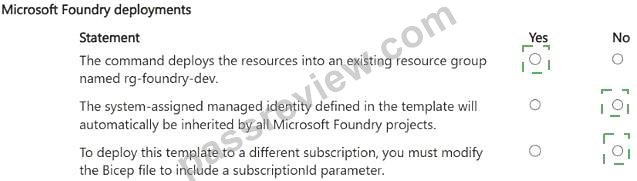
You need to validate what the snippet will do before it is merged. For each of the following statements, select Yes if the statement is true. Otherwise, select No.
NOTE: Each correct selection is worth one point.
Correct Answer:
Explanation:
The command deploys the resources into an existing resource group named rg-foundry-dev: Yes The system-assigned managed identity defined in the template will automatically be inherited by all Microsoft Foundry projects: No To deploy this template to a different subscription, you must modify the Bicep file to include a subscriptionId parameter: No The first statement is Yes . The command uses az deployment group create --resource-group rg-foundry-dev, which performs an Azure Resource Manager deployment at resource-group scope . Microsoft documents that the target resource group must already exist; if it does not, it must be created before running the resource- group deployment.
The second statement is No . The Bicep declaration assigns a system-assigned managed identity to the Foundry resource itself . A Microsoft Foundry project is a child resource and can have its own managed identity . Microsoft explicitly shows project creation with " identity " : { " type " : " SystemAssigned " } and separately discusses assigning permissions to a project ' s managed identity. Therefore, the parent ' s system- assigned identity is not automatically inherited as the identity of every project.
The third statement is No . Because targetScope = ' resourceGroup ' , the same Bicep template can be deployed to a resource group in another subscription without adding a subscriptionId parameter. Azure CLI supports the global --subscription argument, or the active subscription can be changed with az account set.
You have an Azure Machine Learning workspace named Workspace 1 Workspace! has a registered Mlflow model named model 1 with PyFunc flavor You plan to deploy model1 to an online endpoint named endpoint1 without egress connectivity by using Azure Machine learning Python SDK vl You have the following code:
You need to add a parameter to the ManagedOnllneDeployment object to ensure the model deploys successfully Solution: Add the scoring_script parameter.
Does the solution meet the goal?
- A. Yes
- B. No
Correct Answer: A 🗳️
You need to isolate training workloads while remaining cost-aware to address Fabrikam Inc.'s issues, constraints, and technical requirements.
What should you implement?
- A. Fixed-size compute cluster
- B. Managed compute targets with autoscaling
- C. Training jobs that run on a single shared compute cluster
- D. Dedicated compute clusters per experiment
Correct Answer: B 🗳️
Explanation: Only visible for PassReview members. You can sign-up / login (it's free).
Viewing page 1 out of 38 pages.
Viewing questions 1-5 out of 189 questions.

 Kent

 Harry
 Murphy

 Kent
 Ziv
 Malcolm
 Marico
 Molly

 Meroy
 Godfery
 Polly
 Magee
 Martin
 Aldrich
 Rachel
 Gordon


