


Microsoft AB-100 Exam Syllabus Topics:
| Topic | Details |
|---|---|
| Topic 1 |
|
| Topic 2 |
|
| Topic 3 |
|
Since our Microsoft AB-100 exam review materials are accurate and valid our service is also very good. We are 7*24 online service. When you want to ask any questions or share with us your AB-100 passing score you will reply you in 3 hours. We have one-year service warranty that we will send you the latest AB-100 exam review materials if you want or other service. If you pass AB-100 with a good mark and want to purchase other Microsoft exams review materials we will give you discount. Or if you stands for your company and want to long-term cooperate with us we welcome and give you 50%+ discount from the second year.

Our IT system department staff checks the updates every day. Once the AB-100 exam review materials are updated we will notice our customers ASAP. We make sure that all AB-100 exam review materials we sell out are accurate, AB-100 valid and latest. As for the payment we advise people using the Credit Card which is a widely used in international online payments and the safer, faster way to send money, receive money or set up a merchant account for both buyers and sellers. If you have any query about the payment we are pleased to solve for you. (AB-100 pass review - Agentic AI Business Solutions Architect)
We assure you 100% pass for sure. If you fail the AB-100 exam you can send us your unqualified score we will full refund to you or you can choose to change other subject exam too. We aim to "Customer First, Service Foremost", that's why we can become the PassReview in this area.
Instant Download AB-100 Exam Braindumps: Upon successful payment, Our systems will automatically send the product you have purchased to your mailbox by email. (If not received within 12 hours, please contact us. Note: don't forget to check your spam.)
Microsoft Agentic AI Business Solutions Architect Sample Questions:
A company uses a fine-tuned Microsoft Foundry model that requires frequent updates as new customer feedback becomes available.
You need to design an application lifecycle management (ALM) process that meets the following requirements:
Data changes must be tracked and versioned.
The model must be retrained consistently by using approved training data.
Which two actions should you include in the design?
NOTE: Each correct selection is worth one point.
- A. Create a content filter.
- B. Store the training data in Azure Files.
- C. Upload the training data to Microsoft Foundry data files.
- D. Associate the storage location to the fine-tuning job.
- E. Store the training data in Azure Blob Storage that has version control enabled.
Correct Answer: C,E 🗳️
Explanation: Only visible for PassReview members. You can sign-up / login (it's free).
A company has a Microsoft Foundry generative Al model.
You need to evaluate the model ' s output to measure the overall quality and coherence of generated responses. The evaluation must use GPT-4o as a judge and return a numeric score for each output.
Which type of metric should you use?
- A. Al quality (NLP)
- B. Groundedness
- C. risk and safety
- D. Al quality (Al assisted)
Correct Answer: D 🗳️
Explanation: Only visible for PassReview members. You can sign-up / login (it's free).
A company has an Azure environment that supports multiple business units.
The company plans to implement an Al solution that will pertain sentiment analysis on customer product reviews. You need to evaluate the potential cost of the solution to support return on Al investment (ROAI) analysis. What should you use?
- A. Azure Monitor
- B. Microsoft Fabric SKU Estimator
- C. Cost Management + Billing
- D. Azure Reservations
Correct Answer: C 🗳️
Explanation: Only visible for PassReview members. You can sign-up / login (it's free).
A company uses Microsoft 365 and Dynamics 365
You need to recommend a solution lo automatically summarize email threads, generate suggested replies in Microsoft Outlook and provide meeting preparation summaries that include relevant customer relationship management (CRM) data.
Solution: You recommend a classic Microsoft Dataverse workflow.
Does this meet the goal?
- A. Yes
- B. No
Correct Answer: B 🗳️
A company has Microsoft Power Platform development staging, and production environments. Each environment has its own Microsoft Dataverse tables and Azure Al Search index.
You are designing an application lifecycle management (ALM) process to deploy a Microsoft Copilot Studio agent between the environments.
The company has a Copilot Studio agent named Agent! in development. Agent1 uses the following grounding data sources:
* A Dataverse table named CustomerOrders
* An Azure Al Search index named customer-knowledge
You need to deploy Agent1 to production. The solution must ensure that the agent uses the production grounding data sources, minimizes downtime, and handles credentials and endpoints securely.
What should you include in the deployment package solution, and what should you reconfigure after the deployment? To answer, select the appropriate options in the answer area.
NOTE: Each correct selection is worth one point.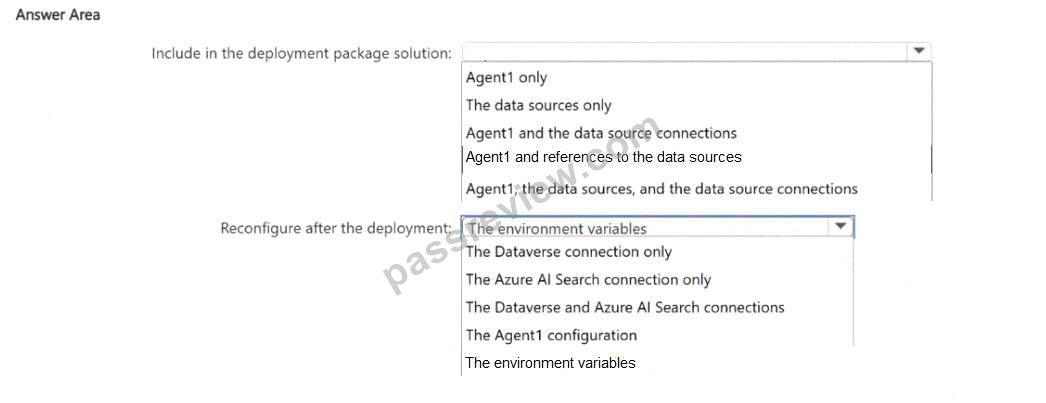
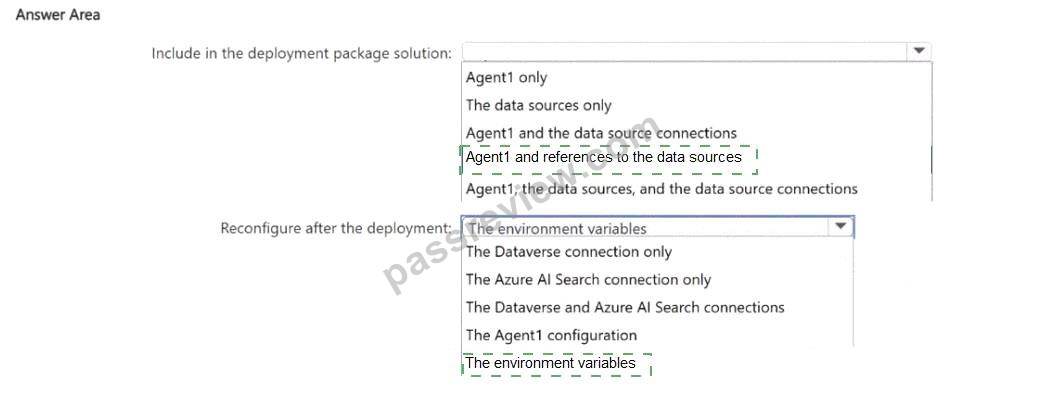
Correct Answer:
Explanation:
In a proper ALM deployment for Microsoft Copilot Studio across development, staging, and production, you should package the agent in a way that is portable across environments while avoiding hardcoded endpoints, indexes, table targets, or credentials.
Here, Agent1 uses:
a Dataverse table: CustomerOrders
an Azure AI Search index: customer-knowledge
Because each environment has its own Dataverse tables and Azure AI Search index, the deployment package should not carry over the development environment's live connections as fixed production settings. Instead, it should carry the agent and the references needed so the target environment can bind to its own production resources.
That is why the correct recommendation is:
Deployment package: Agent1 and references to the data sources
After deployment: Reconfigure the environment variables
Why this is correct:
Environment variables are the standard ALM-friendly way to externalize settings like:
endpoints
index names
table references
connection-related values
This supports secure handling of credentials and endpoints
It also helps minimize downtime, because production values can be switched cleanly after import without rebuilding the agent Why the other choices are weaker:
Agent1 only would omit needed source references
The data sources only would not deploy the actual agent
Agent1 and the data source connections risks carrying environment-specific connection bindings Agent1, the data sources, and the data source connections is too tightly coupled to the source environment and is not the best ALM design for secure cross-environment deployment Reconfiguring only Dataverse or only Azure AI Search is incomplete because both can vary by environment Reconfiguring Agent1 configuration is broader and less precise than using environment variables
Viewing page 1 out of 22 pages.
Viewing questions 1-5 out of 109 questions.

 Jesse

 Orville

 Murray
 Regan

 John
 Ursula
 Sam
 Ken
 Julie
 Wayne
 Harold
 Caesar
 Hale
 John
 Darcy
 Lionel
 Gene
 Meredith
 Lou
 Ethel
 Hugo


