

Use Real Databricks-Certified-Data-Engineer-Professional Dumps - Databricks Correct Answers updated on 2024
Databricks Certification Databricks-Certified-Data-Engineer-Professional Exam Practice Dumps
NEW QUESTION # 72
A Delta table of weather records is partitioned by date and has the below schema:
date DATE, device_id INT, temp FLOAT, latitude FLOAT, longitude FLOAT
To find all the records from within the Arctic Circle, you execute a query with the below filter:
latitude > 66.3
Which statement describes how the Delta engine identifies which files to load?
- A. The Hive metastore is scanned for min and max statistics for the latitude column
- B. All records are cached to attached storage and then the filter is applied Get Latest & Actual Certified-Data-Engineer-Professional Exam's Question and Answers from
- C. The Delta log is scanned for min and max statistics for the latitude column
- D. The Parquet file footers are scanned for min and max statistics for the latitude column
- E. All records are cached to an operational database and then the filter is applied
Answer: C
Explanation:
This is the correct answer because Delta Lake uses a transaction log to store metadata about each table, including min and max statistics for each column in each data file. The Delta engine can use this information to quickly identify which files to load based on a filter condition, without scanning the entire table or the file footers. This is called data skipping and it can improve query performance significantly. Verified Reference: [Databricks Certified Data Engineer Professional], under "Delta Lake" section; [Databricks Documentation], under "Optimizations - Data Skipping" section.
In the Transaction log, Delta Lake captures statistics for each data file of the table. These statistics indicate per file:
- Total number of records
- Minimum value in each column of the first 32 columns of the table
- Maximum value in each column of the first 32 columns of the table
- Null value counts for in each column of the first 32 columns of the table When a query with a selective filter is executed against the table, the query optimizer uses these statistics to generate the query result. it leverages them to identify data files that may contain records matching the conditional filter.
For the SELECT query in the question, The transaction log is scanned for min and max statistics for the price column.
NEW QUESTION # 73
The data architect has mandated that all tables in the Lakehouse should be configured as external Delta Lake tables.
Which approach will ensure that this requirement is met?
- A. Whenever a database is being created, make sure that the location keyword is used Get Latest & Actual Certified-Data-Engineer-Professional Exam's Question and Answers from
- B. When tables are created, make sure that the external keyword is used in the create table statement.
- C. Whenever a table is being created, make sure that the location keyword is used.
- D. When the workspace is being configured, make sure that external cloud object storage has been mounted.
- E. When configuring an external data warehouse for all table storage. leverage Databricks for all ELT.
Answer: C
Explanation:
This is the correct answer because it ensures that this requirement is met. The requirement is that all tables in the Lakehouse should be configured as external Delta Lake tables. An external table is a table that is stored outside of the default warehouse directory and whose metadata is not managed by Databricks. An external table can be created by using the location keyword to specify the path to an existing directory in a cloud storage system, such as DBFS or S3. By creating external tables, the data engineering team can avoid losing data if they drop or overwrite the table, as well as leverage existing data without moving or copying it.
NEW QUESTION # 74
Which statement describes a key benefit of an end-to-end test?
- A. It provides testing coverage for all code paths and branches.
- B. It makes it easier to automate your test suite
- C. It pinpoint errors in the building blocks of your application.
- D. It closely simulates real world usage of your application.
Answer: D
Explanation:
End-to-end testing is a methodology used to test whether the flow of an application, from start to finish, behaves as expected. The key benefit of an end-to-end test is that it closely simulates real- world, user behavior, ensuring that the system as a whole operates correctly.
Get Latest & Actual Certified-Data-Engineer-Professional Exam's Question and Answers from
NEW QUESTION # 75
A junior data engineer is working to implement logic for a Lakehouse table named silver_device_recordings. The source data contains 100 unique fields in a highly nested JSON Get Latest & Actual Certified-Data-Engineer-Professional Exam's Question and Answers from structure.
The silver_device_recordings table will be used downstream for highly selective joins on a number of fields, and will also be leveraged by the machine learning team to filter on a handful of relevant fields, in total, 15 fields have been identified that will often be used for filter and join logic.
The data engineer is trying to determine the best approach for dealing with these nested fields before declaring the table schema.
Which of the following accurately presents information about Delta Lake and Databricks that may Impact their decision-making process?
- A. By default Delta Lake collects statistics on the first 32 columns in a table; these statistics are leveraged for data skipping when executing selective queries.
- B. Schema inference and evolution on Databricks ensure that inferred types will always accurately match the data types used by downstream systems.
- C. Tungsten encoding used by Databricks is optimized for storing string data: newly-added native support for querying JSON strings means that string types are always most efficient.
- D. Because Delta Lake uses Parquet for data storage, Dremel encoding information for nesting can be directly referenced by the Delta transaction log.
Answer: A
Explanation:
Delta Lake, built on top of Parquet, enhances query performance through data skipping, which is based on the statistics collected for each file in a table. For tables with a large number of columns, Delta Lake by default collects and stores statistics only for the first 32 columns. These statistics include min/max values and null counts, which are used to optimize query execution by skipping irrelevant data files. When dealing with highly nested JSON structures, understanding this behavior is crucial for schema design, especially when determining which fields should be flattened or prioritized in the table structure to leverage data skipping efficiently for performance optimization.
NEW QUESTION # 76
A nightly job ingests data into a Delta Lake table using the following code: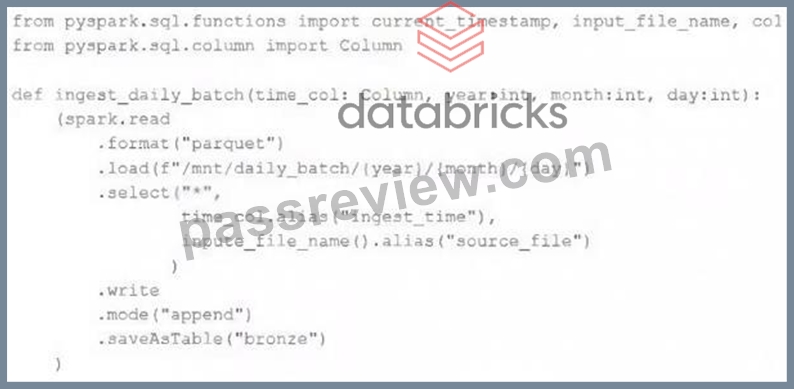
The next step in the pipeline requires a function that returns an object that can be used to manipulate new records that have not yet been processed to the next table in the pipeline.
Which code snippet completes this function definition?
- A. return spark.readStream.table("bronze")
- B. return spark.readStream.load("bronze")
- C. return spark.read.option("readChangeFeed", "true").table ("bronze")
- D.

- E. def new_records():
Answer: D
Explanation:
https://docs.databricks.com/en/delta/delta-change-data-feed.html
Get Latest & Actual Certified-Data-Engineer-Professional Exam's Question and Answers from
NEW QUESTION # 77
A CHECK constraint has been successfully added to the Delta table named activity_details using the following logic: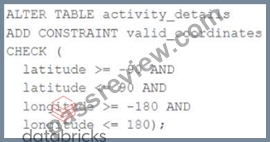
A batch job is attempting to insert new records to the table, including a record where latitude =
45.50 and longitude = 212.67.
Which statement describes the outcome of this batch insert?
- A. The write will include all records in the target table; any violations will be indicated in the boolean column named valid_coordinates.
- B. The write will fail completely because of the constraint violation and no records will be inserted into the target table.
- C. The write will fail when the violating record is reached; any records previously processed will be recorded to the target table.
- D. The write will insert all records except those that violate the table constraints; the violating records will be reported in a warning log.
- E. The write will insert all records except those that violate the table constraints; the violating records will be recorded to a quarantine table.
Answer: B
Explanation:
The CHECK constraint is used to ensure that the data inserted into the table meets the specified conditions. In this case, the CHECK constraint is used to ensure that the latitude and longitude values are within the specified range. If the data does not meet the specified conditions, the write operation will fail completely and no records will be inserted into the target table. This is because Delta Lake supports ACID transactions, which means that either all the data is written or none of it is written. Therefore, the batch insert will fail when it encounters a record that violates the Get Latest & Actual Certified-Data-Engineer-Professional Exam's Question and Answers from constraint, and the target table will not be updated.
NEW QUESTION # 78
The data engineer team has been tasked with configured connections to an external database that does not have a supported native connector with Databricks. The external database already has data security configured by group membership. These groups map directly to user group already created in Databricks that represent various teams within the company. A new login credential has been created for each group in the external database. The Databricks Utilities Secrets module will be used to make these credentials available to Databricks users. Assuming that all the credentials are configured correctly on the external database and group membership is properly configured on Databricks, which statement describes how teams can be granted the minimum necessary access to using these credentials?
- A. No additional configuration is necessary as long as all users are configured as administrators in the workspace where secrets have been added.
- B. "Read'' permissions should be set on a secret key mapped to those credentials that will be used by a given team.
- C. "Read" permissions should be set on a secret scope containing only those credentials that will be used by a given team.
- D. "Manage" permission should be set on a secret scope containing only those credentials that will be used by a given team.
Answer: C
Explanation:
In Databricks, using the Secrets module allows for secure management of sensitive information such as database credentials. Granting 'Read' permissions on a secret key that maps to database credentials for a specific team ensures that only members of that team can access Get Latest & Actual Certified-Data-Engineer-Professional Exam's Question and Answers from these credentials. This approach aligns with the principle of least privilege, granting users the minimum level of access required to perform their jobs, thus enhancing security.
NEW QUESTION # 79
A data team's Structured Streaming job is configured to calculate running aggregates for item sales to update a downstream marketing dashboard. The marketing team has introduced a new field to track the number of times this promotion code is used for each item. A junior data engineer suggests updating the existing query as follows: Note that proposed changes are in bold.
Original query:
Get Latest & Actual Certified-Data-Engineer-Professional Exam's Question and Answers from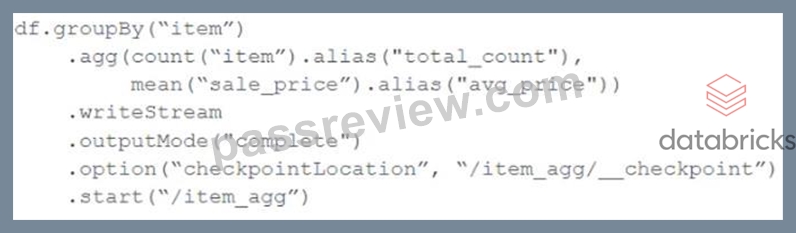
Proposed query: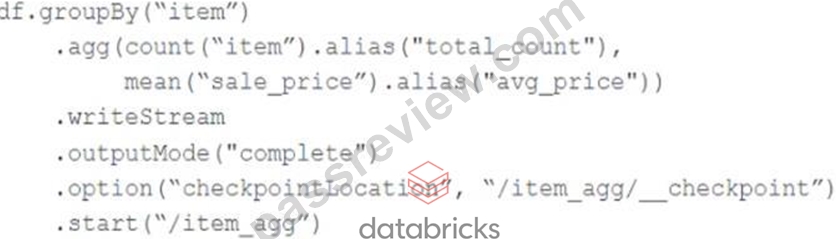
Proposed query:
.start("/item_agg")
Which step must also be completed to put the proposed query into production?
- A. Run REFRESH TABLE delta, /item_agg'
- B. Increase the shuffle partitions to account for additional aggregates
- C. Specify a new checkpointlocation
- D. Remove .option (mergeSchema', true') from the streaming write
- E. Register the data in the "/item_agg" directory to the Hive metastore
Answer: C
Explanation:
When introducing a new aggregation or a change in the logic of a Structured Streaming query, it is generally necessary to specify a new checkpoint location. This is because the checkpoint directory contains metadata about the offsets and the state of the aggregations of a streaming query. If the logic of the query changes, such as including a new aggregation field, the state information saved in the current checkpoint would not be compatible with the new logic, potentially leading to incorrect results or failures. Therefore, to accommodate the new field and ensure the streaming job has the correct starting point and state information for aggregations, a new checkpoint location should be specified.
NEW QUESTION # 80
A data engineer needs to capture pipeline settings from an existing in the workspace, and use them to create and version a JSON file to create a new pipeline. Which command should the data engineer enter in a web terminal configured with the Databricks CLI?
- A. Stop the existing pipeline; use the returned settings in a reset command
- B. Use list pipelines to get the specs for all pipelines; get the pipeline spec from the return results parse and use this to create a pipeline
- C. Use the get command to capture the settings for the existing pipeline; remove the pipeline_id and rename the pipeline; use this in a create command
- D. Use the alone command to create a copy of an existing pipeline; use the get JSON command to get the pipeline definition; save this to git
Answer: C
Explanation:
The Databricks CLI provides a way to automate interactions with Databricks services. When dealing with pipelines, you can use the databricks pipelines get --pipeline-id command to capture the settings of an existing pipeline in JSON format. This JSON can then be modified by removing the pipeline_id to prevent conflicts and renaming the pipeline to create a new pipeline. The modified JSON file can then be used with the databricks pipelines create command to create a new pipeline with those settings.
Get Latest & Actual Certified-Data-Engineer-Professional Exam's Question and Answers from
NEW QUESTION # 81
Which statement describes Delta Lake Auto Compaction?
- A. Data is queued in a messaging bus instead of committing data directly to memory; all data is committed from the messaging bus in one batch once the job is complete.
- B. An asynchronous job runs after the write completes to detect if files could be further compacted; if yes, an optimize job is executed toward a default of 128 MB.
- C. Optimized writes use logical partitions instead of directory partitions; because partition boundaries are only represented in metadata, fewer small files are written.
- D. An asynchronous job runs after the write completes to detect if files could be further compacted; if yes, an optimize job is executed toward a default of 1 GB.
- E. Before a Jobs cluster terminates, optimize is executed on all tables modified during the most recent job.
Get Latest & Actual Certified-Data-Engineer-Professional Exam's Question and Answers from
Answer: B
Explanation:
This is the correct answer because it describes the behavior of Delta Lake Auto Compaction, which is a feature that automatically optimizes the layout of Delta Lake tables by coalescing small files into larger ones. Auto Compaction runs as an asynchronous job after a write to a table has succeeded and checks if files within a partition can be further compacted. If yes, it runs an optimize job with a default target file size of 128 MB. Auto Compaction only compacts files that have not been compacted previously.
NEW QUESTION # 82
A task orchestrator has been configured to run two hourly tasks. First, an outside system writes Parquet data to a directory mounted at /mnt/raw_orders/. After this data is written, a Databricks job containing the following code is executed:
Get Latest & Actual Certified-Data-Engineer-Professional Exam's Question and Answers from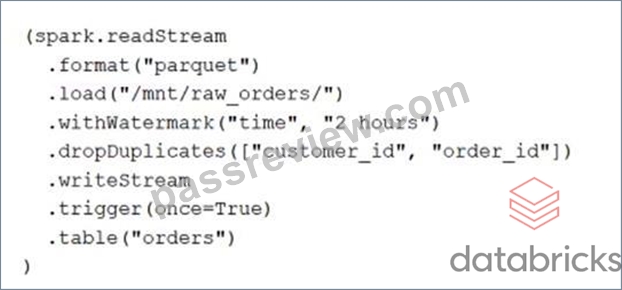
Assume that the fields customer_id and order_id serve as a composite key to uniquely identify each order, and that the time field indicates when the record was queued in the source system.
If the upstream system is known to occasionally enqueue duplicate entries for a single order hours apart, which statement is correct?
- A. The orders table will not contain duplicates, but records arriving more than 2 hours late will be ignored and missing from the table.
- B. Duplicate records enqueued more than 2 hours apart may be retained and the orders table may contain duplicate records with the same customer_id and order_id.
- C. All records will be held in the state store for 2 hours before being deduplicated and committed to the orders table.
- D. Duplicate records arriving more than 2 hours apart will be dropped, but duplicates that arrive in the same batch may both be written to the orders table.
- E. The orders table will contain only the most recent 2 hours of records and no duplicates will be present.
Answer: B
NEW QUESTION # 83
A data architect has heard about lake's built-in versioning and time travel capabilities. For auditing purposes they have a requirement to maintain a full of all valid street addresses as they appear in the customers table.
The architect is interested in implementing a Type 1 table, overwriting existing records with new values and relying on Delta Lake time travel to support long-term auditing. A data engineer on the project feels that a Type 2 table will provide better performance and scalability. Which piece of Get Latest & Actual Certified-Data-Engineer-Professional Exam's Question and Answers from information is critical to this decision?
- A. Delta Lake time travel does not scale well in cost or latency to provide a long-term versioning solution.
- B. Delta Lake only supports Type 0 tables; once records are inserted to a Delta Lake table, they cannot be modified.
- C. Data corruption can occur if a query fails in a partially completed state because Type 2 tables requires setting multiple fields in a single update.
- D. Delta Lake time travel cannot be used to query previous versions of these tables because Type 1 changes modify data files in place.
- E. Shallow clones can be combined with Type 1 tables to accelerate historic queries for long-term versioning.
Answer: A
Explanation:
Delta Lake's time travel feature allows users to access previous versions of a table, providing a powerful tool for auditing and versioning. However, using time travel as a long-term versioning solution for auditing purposes can be less optimal in terms of cost and performance, especially as the volume of data and the number of versions grow. For maintaining a full history of valid street addresses as they appear in a customers table, using a Type 2 table (where each update creates a new record with versioning) might provide better scalability and performance by avoiding the overhead associated with accessing older versions of a large table. While Type 1 tables, where existing records are overwritten with new values, seem simpler and can leverage time travel for auditing, the critical piece of information is that time travel might not scale well in cost or latency for long-term versioning needs, making a Type 2 approach more viable for performance and scalability.
NEW QUESTION # 84
The data governance team is reviewing code used for deleting records for compliance with GDPR. They note the following logic is used to delete records from the Delta Lake table named users.
Assuming that user_id is a unique identifying key and that delete_requests contains all users that have requested deletion, which statement describes whether successfully executing the above logic guarantees that the records to be deleted are no longer accessible and why?
- A. No; files containing deleted records may still be accessible with time travel until a vacuum command is used to remove invalidated data files.
- B. Yes; the Delta cache immediately updates to reflect the latest data files recorded to disk.
- C. No; the Delta Lake delete command only provides ACID guarantees when combined with the merge into command.
- D. No; the Delta cache may return records from previous versions of the table until the cluster is restarted.
- E. Yes; Delta Lake ACID guarantees provide assurance that the delete command succeeded fully and permanently purged these records.
Answer: A
Explanation:
Get Latest & Actual Certified-Data-Engineer-Professional Exam's Question and Answers from Explanation:
The code uses the DELETE FROM command to delete records from the users table that match a condition based on a join with another table called delete_requests, which contains all users that have requested deletion. The DELETE FROM command deletes records from a Delta Lake table by creating a new version of the table that does not contain the deleted records. However, this does not guarantee that the records to be deleted are no longer accessible, because Delta Lake supports time travel, which allows querying previous versions of the table using a timestamp or version number. Therefore, files containing deleted records may still be accessible with time travel until a vacuum command is used to remove invalidated data files from physical storage.
NEW QUESTION # 85
The data engineering team maintains a table of aggregate statistics through batch nightly updates. This includes total sales for the previous day alongside totals and averages for a variety of time periods including the 7 previous days, year-to-date, and quarter-to-date. This table is named store_saies_summary and the schema is as follows:
The table daily_store_sales contains all the information needed to update store_sales_summary.
The schema for this table is:
store_id INT, sales_date DATE, total_sales FLOAT
Get Latest & Actual Certified-Data-Engineer-Professional Exam's Question and Answers from If daily_store_sales is implemented as a Type 1 table and the total_sales column might be adjusted after manual data auditing, which approach is the safest to generate accurate reports in the store_sales_summary table?
- A. Implement the appropriate aggregate logic as a batch read against the daily_store_sales table and append new rows nightly to the store_sales_summary table.
- B. Implement the appropriate aggregate logic as a batch read against the daily_store_sales table and overwrite the store_sales_summary table with each Update.
- C. Implement the appropriate aggregate logic as a batch read against the daily_store_sales table and use upsert logic to update results in the store_sales_summary table.
- D. Implement the appropriate aggregate logic as a Structured Streaming read against the daily_store_sales table and use upsert logic to update results in the store_sales_summary table.
- E. Use Structured Streaming to subscribe to the change data feed for daily_store_sales and apply changes to the aggregates in the store_sales_summary table with each update.
Answer: B
NEW QUESTION # 86
The data science team has created and logged a production model using MLflow. The model accepts a list of column names and returns a new column of type DOUBLE.
The following code correctly imports the production model, loads the customers table containing the customer_id key column into a DataFrame, and defines the feature columns needed for the model.
Which code block will output a DataFrame with the schema "customer_id LONG, predictions DOUBLE"?
- A. df.select("customer_id", pandas_udf(model, columns).alias("predictions"))
- B. model.predict(df, columns)
- C. df.select("customer_id", model(*columns).alias("predictions"))
- D. df.map(lambda x:model(x[columns])).select("customer_id, predictions")
- E. df.apply(model, columns).select("customer_id, predictions")
Answer: C
Explanation:
This code block applies the Spark UDF created from the MLflow model to the DataFrame df by selecting the existing customer_id column and the new column produced by the model, which is aliased to predictions. The model(*columns) part is where the UDF is applied to the columns specified in the columns list, and alias("predictions") is used to name the output column of the model's predictions. This will result in a DataFrame with the desired schema: "customer_id LONG, predictions DOUBLE".
NEW QUESTION # 87
......
Get ready to pass the Databricks-Certified-Data-Engineer-Professional Exam right now using our Databricks Certification Exam Package: https://www.passreview.com/Databricks-Certified-Data-Engineer-Professional_exam-braindumps.html